There were a dozen soldiers in the truck's bed,
holding strange guns
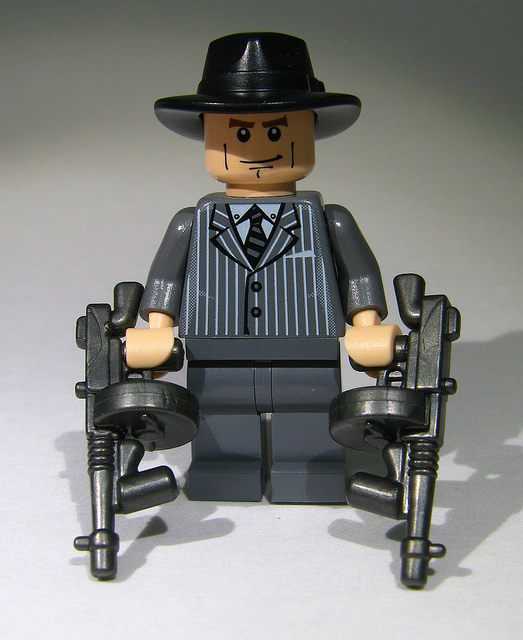
that looked like old props from a B&W gangster movie, with large drums on the barrels. Al Capone and Elliot Ness would've probably called them "tommy-guns," Peter recalled. [From Peter's distant childhood memories, the old slang "tommy-gun" suddenly arose. That's what guns of this design had been called when Peter played cops-and-robbers as a little boy in the 1950s.] Sometimes, instead, it had been cowboys-and-Indians, with the kids forming their fingers into Colt revolvers, not tommy-guns. But even more often, in the '50s, it had been "the Army versus the Reds" -- or "humans versus Martians". Only adulthood, and college psychology textbooks, had brought the realization that those childhood "Martians", all along, had really been "proxy-Reds".
Glancing at Ann, Peter felt a sudden twinge of guilt, though of course right NOW it would be another 15 years or so before Hollywood began to re-imagine Ann and her people as green-skinned, skull-faced invaders, especially after Sputnik scared the hell out of Americans. (Peter had been -- no, would be! -- six or seven, but he would never forget his dad pointing out the tiny metal basketball moving dimly across the stars: "No, Petey, it's not a shooting star -- they go much faster." Of course, he was slightly too young to remember that the Soviets had successfully tested the A-bomb in 1949, and the hydrogen bomb in 1953 -- but he clearly recalled the grim worry in his mom's eyes when his dad tried to explain what a "spoot-neek" was. His parents, being self-educated bookworms who encouraged Peter to read science magazines, had attempted to use the correct Russian pronunciation for a week or so, but had then fallen into the Americanized "spuht-nick" like everyone else -- they took pride in education, of course, but even so, there was no point in SOUNDING too much like a Red!)
Still later, in the '60s, after the Mutually Assured Destruction doctrine had introduced a bizarre peace that even Lewis Carroll would have thought too nonsensical for words, color television had finally arrived in Peter's home. And along with it had come the Klingons of _Star Trek_ as a whole new breed of "space Commies" -- who no longer threatened to invade Earth itself, but who were still locked in a perpetual Cold War with the "American" Earthlings for dominion over unclaimed territories of the galaxy.
Again, only as an adult would Peter later figure out that although Lt. Chekov from _Star Trek_ spoke with a Russian accent (or a bad imitation of one), and would even boast proudly to Captain Kirk about "ROO-shun in-WEN-shuns", Chekov was REALLY some sort of naturalized Russian-American, at least on the level of Freudian/Jungian subtext that Hollywood screenwriters had all learned about in college literature classes. An immigrant with a funny accent, perhaps, and a minority with ethnic pride in his grandparents' ways, but still properly belonging in America, just like Lt. Sulu and "Scotty" and Spock and Uhura -- she was definitely born in Africa, as _Star Trek_ fans knew, but had no accent at all, and wore a daringly sexy miniskirt like any stylish American girl from the 1960s.
As for Spock -- one could argue (and many had!) that the Vulcans were symbolically intended to be "space Jews". But if so, then green-blooded, pointy-eared Spock was nevertheless, beyond any doubt, a Jewish-American -- and therefore, to Peter, he was one of OURS, despite his odd Vulcan habits -- not a menacing foreigner like THOSE Klingons and Romulans! (The only point of uncertainty was whether the Klingons were "Rooskies" and the Romulans were "Ching-chongs," or vice-versa.))))))
The brief interlude of WW2, when the US and USSR were friends-of-necessity allied against the Nazis, had never been a part of Peter's everyday consciousness as an American born in 1951. For about four decades of his life, the Soviets had been an alien threat; and for two decades after that, the "Soviets" had become "Russians" -- no longer quite as threatening, but still rather alien, and not to be confused with NICE Russian-Americans, like Lt. Pavel Chekov from _Star Trek_, and Martina Navratilova, and Mikhail Baryshnikov, and Yakov Smirnoff...
The truck pulled up right in front of the sergeant...



 10Likes
 LinkBack URL
 About LinkBacks




 Говорит Бегемот:
 Reply With Quote
