
 2Likes
 LinkBack URL
 About LinkBacks
I'm the only member that's keeping you on your feet
What's the difference between зайди́ and войди́?


I'm the only member that's keeping you on your feet
What's the difference between зайди́ and войди́?
"Особенно упорно надо заниматься тем, кто ничего не знает." - Като Ломб
"В один прекрасный день все ваши подспудные знания хлынут наружу. Ощущения при этом замечательные, уверяю вас." -Кто-то

These are verbs of motion in the imperative forms, yes?
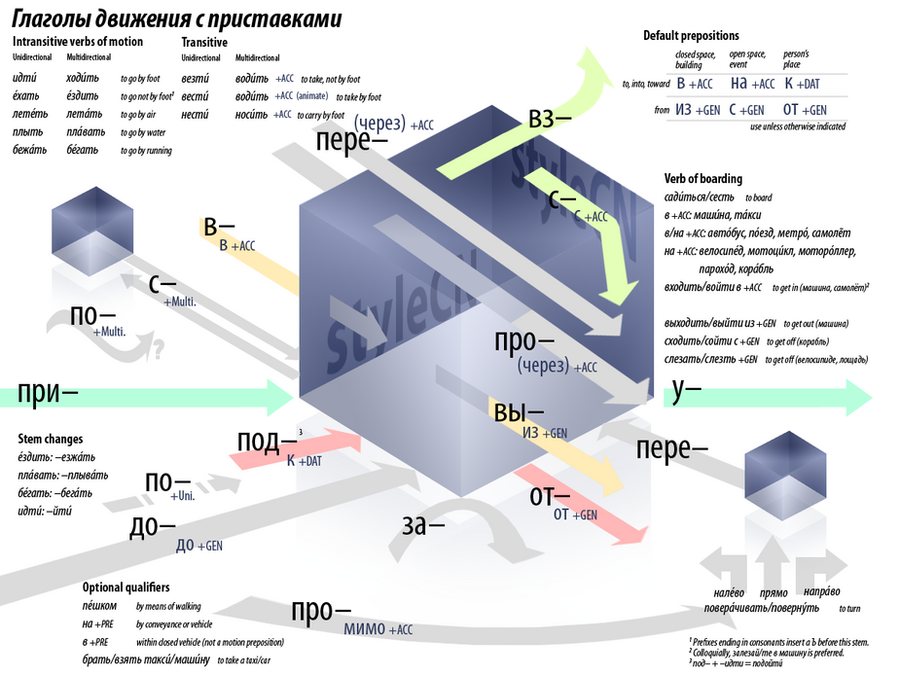
Note that they are both the prefixed perfective forms from the verb идти 'to go'. In situations like this, it helps to study prefixes and what they mean:
в(о)- meaning enter (motion into)
за -can represent the beginning of a repeated motion, a short visit to somebody or some place ("dropping in somewhere")
I hope this helps you understand the verbs in the context you are pulling them out of.
Oh, I didn't know both are prefixes of the same word at all! So that does help me understand it better.
So зайди́ is better for "зайди́ к туале́ту" whereas войди́ would do better in "войди́ к гостинице"...
Yes, I think I got it
зайди в туалетOriginally Posted by Valda

войди в гостиницу
Войди в гостиницу. You are indicating motion into, so from my understanding, it'd make more sense to use accusative.
"Зайди" - we can cay - зайди за дерево, зайди за угол - to move behind some object.
Also, Солнце can зайти only.
Солнце зашло - mean, Sun moved down, lower then horizon.
Does this not require the instrumental? I read somewhere that за meaning 'behind' takes instrumental. Maybe I am wrong?
No, it uses accusative.


Some prepositions take more than one case, depending on circumstance. За uses instrumental when it describes a position, eg за дверью behind door etc. (вперёд, за, между, над, под take instrumental) Other times it takes accusative, спасибо за помощь is accusative. "Что это за пьяные выходки?" accusative from movie "Иван Васильевич..."
It's nominative."Что это за пьяные выходки?" accusative from movie "Иван Васильевич..."
Oh! I see, thanks.
I don't understand exactly, but this phrases doesn't require anything.
Consider this a difference the same as between "in" and "into", "at" and "to". Just like "на" and "в" require Prepositional for expressing a location and Accusative for describing a detination of movement, "за" takes a noun in Accusative when you are describing motion with a goal to get behind something. When you are simply telling the position behind some object, it takes Instrumental. Even when the position is not itself static

Not perfect but nice. Still I don't understand what is lower пере-.
"Россия для русских" - это неправильно. Остальные-то чем лучше?
I think it's differentiating between moving across something and moving from one place to the other. I guess that's sort of the same thing, but it's the difference between:
Я перешел дорогу.
and
я переехал из России в США.
Ah, I got it. The smaller cube is another place.
"Россия для русских" - это неправильно. Остальные-то чем лучше?
left bottom corner - wrong stress
пешкОм not пЕшком
This was the clarification I was looking for. Спасибо большое!
 Posting Permissions

Russian Lessons | Russian Tests and Quizzes | Russian Vocabulary |


 Reply With Quote