


 LinkBack URL
 About LinkBacks


One can't rule out the possibility that the names on the cup belonged to Japanese war veterans, but to me it seems just as likely that they were members of Vladivostok's civilian Japanese community.Also, a friend of my sister wrote me and suggested "the first line of Russian that your friend sites below (HA DOBRYIU .....) means “to the beloved memory of the regiment of Daito (name of leader), followed by the names of his warriors." What do you think?
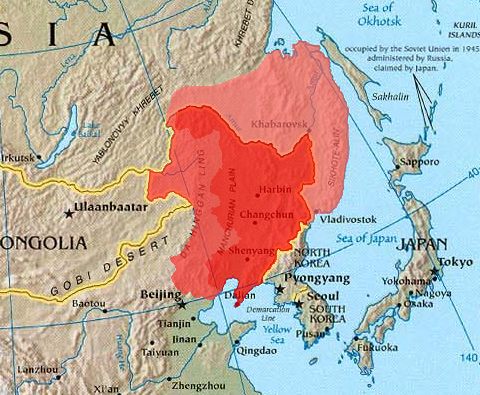
Keep in mind that Vladivostok itself was never the scene of any massive fighting between Japan and Russia. True, during the Russo-Japanese War of 1904-05, some Japanese warships fired a bunch of artillery shells at the city, but the attack was of limited scale, and apparently Japan had no ambitions to either destroy Vladivostok, or to capture it and make it a Japanese port. Japan was MUCH more interested in acquiring what was then the Russian-controlled Port Arthur, which is now the Chinese city of Lushunkou. If you look at the map below, Port Arthur was at the very tip of the "Dalian" peninsula, halfway between Beijing and Pyongyang, on the opposite side of the Korean peninsula from Vladivostok:
And during the course of the R-J war, not only did Japan eventually capture Port Arthur, but they kicked the Russian Navy's ass to hell and back in the battle of Tsushima Strait -- on the map, that narrow bit of water between Pusan, South Korea, and Fukuoka, Japan. However, the few Russian warships that survived Tsushima were allowed to escape to Vladivostok, and the Japanese chose not to chase them. So Vladivostok didn't become a major battle zone in that war.
As I mentioned, Japanese troops were stationed in Vladivostok from 1918-22. But they were part of a limited international "police" force that was mainly there to prevent Bolshevik "activists" from vandalizing and harassing foreign-owned business interests. They were certainly unprepared to fight the entire Russian Army, and they pulled out completely in 1922.
Still, it's possible that the names on the cup were Japanese veterans who had either participated in the 1904-05 war against Russia, or who'd been briefly stationed in Vladivostok in 1918-22. However, I doubt that anyone wearing a Japanese uniform would've been allowed anywhere near Vladivostok in 1926, when the cup was engraved, so if they were indeed military veterans, they were presumably visiting as civilians.


 Говорит Бегемот:
 Reply With Quote
